Since its introduction, vRS – standing for ‘victory rally sport’ – has served a dual purpose. For Škoda, it has acted as a performance halo and technical proving ground, enabling engineers to introduce new powertrains, drivetrains and chassis technologies. For customers, it represents accessible performance: cars that deliver genuine pace and driver engagement, while retaining the space, practicality and value for which Škoda is known.
This philosophy draws from more than a century of motorsport heritage. From early competition cars such as the Popular Monte Carlo and 966 Supersport, through to the iconic 180/200 RS and legendary 130 RS, Škoda has formidable sporting pedigree. This continues today with international rally success with the Fabia R5 and the latest 2025 Fabia RS Rally2. This competitive spirit has consistently influenced the engineering integrity and real-world capability of Škoda’s road-going vRS models.
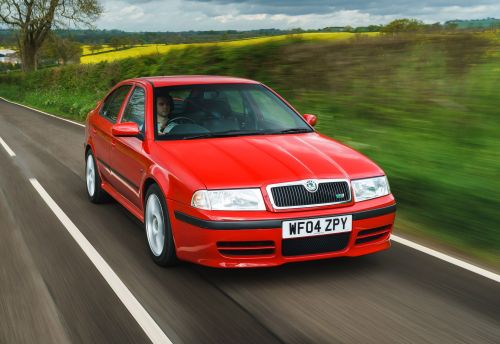
Octavia vRS Mk1 (2001–2006)
The launch of the Octavia vRS Mk1 in 2001 marked a turning point for Škoda in the UK, signalling the return of the RS nameplate (renamed vRS for the UK) and redefining perceptions of the brand. Powered by a 1.8-litre turbocharged petrol engine producing 180PS, it was the most powerful, fastest and most expensive production Škoda of its time, capable of reaching 146mph.
A bespoke chassis fine-tuned by Škoda Motorsport – combined with WRC-inspired styling cues – delivered genuine driver appeal, while seating for five and up to 580 litres of luggage space ensured the Octavia vRS established the core vRS principle of everyday performance.
Fabia vRS Mk1 (2003–2007)
Škoda challenged convention with the introduction of the Fabia vRS, adopting a 1.9-litre turbodiesel engine at a time when rivals relied on high-revving petrol power. Producing 130PS and a class-leading 310Nm of torque, the Fabia vRS delivered strong real-world performance alongside fuel economy of up to 53.3mpg. Its five-door practicality, light weight and torque-rich character made it particularly well suited to UK roads.
Octavia vRS Mk2 (2005–2013)
The second-generation Octavia vRS built on early success with increased refinement, performance and choice. A new 2.0-litre TSI petrol engine delivered 200PS, while the later introduction of a 170PS diesel variant offered even greater torque at 350Nm, further underlining Škoda’s confidence in performance diesel technology and aligning with the trends of the time. Offered as both a hatchback and estate, the Mk2 vRS broadened the appeal of the badge and continued to combine performance with everyday usability.
This generation also delivered one of vRS’s most notable moments when a specially prepared Octavia set a 227.080mph 2.0 litre forced-induction land speed record at the Bonneville Salt Flats in 2011, to mark the 10th anniversary of vRS. The car featured bespoke streamlining and a fully modified version of the road car’s engine, producing circa 600PS.
Fabia vRS Mk2 (2010–2013)
Launched in 2010, the second-generation Fabia vRS moved to petrol power, featuring a technically advanced 1.4-litre engine combining turbocharging and supercharging to produce 180PS. Paired with a seven-speed DSG transmission, it accelerated from 0-62mph in 7.3 seconds. Chassis revisions, sharper steering, firmer suspension and the introduction of the XDS electronic differential delivered a more focused and engaging driving experience, demonstrating Škoda’s growing sophistication in chassis and drivetrain integration.
Octavia vRS Mk3 (2013–2020)
The third-generation Octavia vRS marked a significant step forward in maturity and breadth, offering the widest range of body styles, powertrains and drivetrains in the model’s history. Petrol and diesel engines delivered up to 220PS and 184PS respectively, later joined by the higher performance vRS 230. Advanced chassis technologies, including multi-link rear suspension and integrated electronic differential systems, improved traction and control, while class-leading interior space ensured the Octavia vRS remained as practical as it was performance-focused.
Kodiaq vRS Mk1 (2019–2024)
The introduction of the Kodiaq vRS demonstrated the adaptability of the vRS concept, applying performance engineering to a seven-seat SUV. Initially powered by the most powerful diesel engine ever fitted to a production Škoda – a 2.0-litre biturbo unit producing 239PS and 500Nm – the all-wheel-drive Kodiaq vRS combined performance with practicality. Its capabilities were underlined by a Nürburgring Nordschleife lap record for a seven-seat SUV, before a later transition to a 245PS petrol engine reflected Škoda’s evolving performance powertrain strategy.
Octavia vRS Mk4 and Octavia vRS iV (2020–present)
The fourth-generation Octavia vRS expanded the badge’s remit further, with increased choice, more power and new technology. Customers really had their choice of vRS, with petrol and diesel (including manual and DSG options, plus front- or all-wheel drive choices) and, for the first time, a plug-in hybrid powertrain. Octavia vRS iV combined a 1.4-litre petrol engine with an electric motor to deliver 245PS and 400Nm, alongside an all-electric range of up to 38 miles. This marked a key transition point for vRS, demonstrating how electrification could enhance performance.
The Octavia vRS Mk4 updated in 2025, introducing a series of focused and purposeful enhancements. Central to these updates was a revised 2.0-litre TSI engine, now producing 265PS, a gain of 20PS, along with 370Nm of torque. The vRS also gained a newly developed sports exhaust as standard, reinforcing its performance credentials while preserving the model’s everyday usability.
Kodiaq vRS Mk2 (2025-present)
The second-generation Kodiaq vRS built upon the established strengths of its predecessor, further showcasing the versatility of the vRS philosophy when applied to a large family SUV. Power came from an uprated 2.0-litre TSI turbocharged petrol engine, shared with the facelifted Octavia vRS, delivering enhanced performance through a seven-speed DSG transmission and all-wheel-drive system. This combination enables the Kodiaq vRS to accelerate from 0-62mph in just 6.4 seconds.
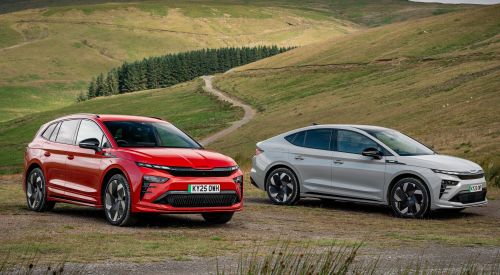
Enyaq vRS and Enyaq Coupé vRS (2023–present)
Enyaq vRS and Enyaq Coupé vRS marked Škoda’s move into fully electric vRS performance. Positioning the badge at the forefront of the brand’s electric strategy, they feature dual-motors, all-wheel drive and outputs of up to 340PS, and a 0-62mph acceleration time of just 5.5 seconds – becoming the most powerful production Škoda models ever at launch. Instant torque delivery, combined with bespoke chassis tuning, uprated brakes and advanced vehicle dynamics systems, ensured confident performance without compromising the space, refinement and practicality expected of a Škoda SUV.
In 2023, the Enyaq vRS further demonstrated its performance credentials by achieving two Guinness World Records on ice. It surpassed the existing record for the longest continuous vehicle drift on ice and set a new benchmark as the longest ice drift by an electric vehicle, completing a controlled 7.351km (4.568mi) run. The achievement highlighted the effectiveness of the Enyaq’s dual-motor all-wheel drive, balanced chassis tuning and advanced vehicle dynamics, even in extreme low-grip conditions.
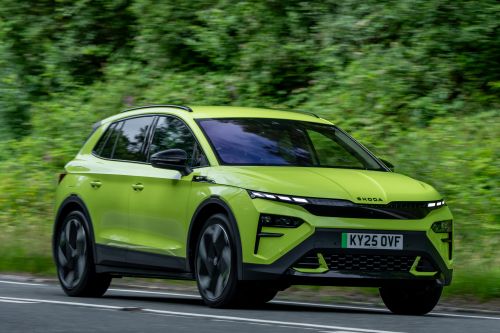
Elroq vRS (2025–present)
The Elroq vRS extends electric vRS performance into the compact SUV segment, applying the badge’s established performance principles to a new generation of electric vehicles. Equipped with two electric motors generating a total system output of 340PS (250kW) through an all-wheel drive system, the Elroq became the fastest accelerating car in Škoda’s current model portfolio, taking it from 0-62 mph in 5.4 seconds. Elroq vRS further highlights vRS’ design ethos by delivering this thrilling performance without compromising on range, with up to 339 miles, making it the ideal everyday companion.
GR Snippets
- 2026 marks 25 years since the first vRS model launched in the UK, beginning with the Mk1 Octavia vRS
- The iconic badge has evolved into a performance icon, combining motorsport-inspired engineering with everyday usability
- Over the years, vRS has spanned turbocharged petrol, diesel, hybrid and fully electric powertrains
